

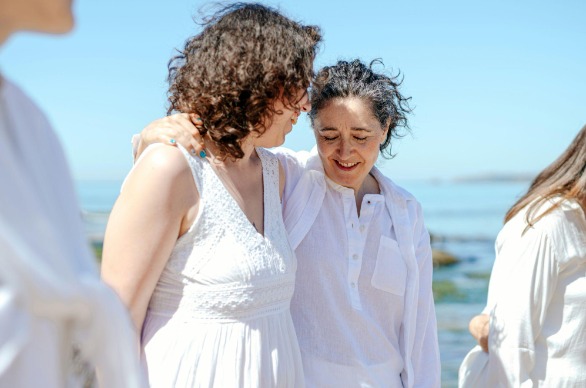
There is something about the sea that has drawn human beings to it at moments of loss for as long as there have been human beings to lose. The horizon that extends beyond sight. The movement that never fully stills. The sense of something vast and continuous that persists regardless of what has happened to the individual standing at its edge. These qualities have made water a site of farewell across cultures and centuries in ways that no single tradition owns and no single explanation fully accounts for.
The sea farewell as a contemporary memorial format has grown significantly in recent years, as families looking for something that feels more personal and more connected to the natural world than a chapel service have discovered that the water offers a setting for goodbye that few other environments replicate. Understanding what a sea farewell actually involves, and what produces the quality of experience that families consistently describe, is useful for anyone considering whether this format might be the right one for the person they’re remembering.
What a Sea Farewell Actually Involves
A sea farewell combines a direct cremation, which handles all the legal and practical requirements of the death, with a family-arranged memorial at a water location of the family’s choosing, at a time that suits them rather than one determined by a facility’s schedule.
The direct cremation handles the transfer of the deceased, all documentation including death registration, the cremation itself, and the return of the ashes to the family. The ashes are typically ready within three to five days of the cremation, packaged with the memorial items and an export permit that allows the family to travel with them if needed. The family then plans the memorial separately, choosing the location, the timing, and the format of the gathering.
The ashes are placed in a biodegradable vessel designed specifically for water release. A sea pillow holds the ashes in a natural fabric casing that can be placed gently on the water’s surface and allowed to drift before gradually biodegrading and releasing the ashes into the sea. A scattering tube provides a more direct release, allowing the ashes to be scattered from a vessel, a pier, a beach, or a clifftop into the water below. Both options are designed to make the physical act of releasing the ashes as gentle and as meaningful as the moment deserves.
The memorial package typically includes plantable hearts made from biodegradable materials embedded with native flower seeds, which can be given to those present as a living reminder of the person who has passed. The physical elements of the memorial, the urn, the plantable hearts, the photo frame, arrive together with the ashes so that everything needed for the gathering is in the family’s hands before the memorial date.
Why the Setting Produces a Different Kind of Grief Experience
The outdoor setting of a sea memorial produces a quality of emotional experience that indoor services don’t generate in the same way, and the specific qualities of water and coastline contribute to that difference in ways worth understanding.
The openness of a coastal environment removes the containing architecture of a chapel or function room. Grief at the edge of the sea happens in a space that extends in every direction rather than being bounded by walls, and many people describe that openness as allowing the emotion to be felt more fully rather than being managed within a defined space. The sea itself, its movement, its sound, and the way it connects the place where the memorial is happening to everywhere else that water connects, creates a sense of scale that puts the individual loss in a larger context without diminishing it.
The physical act of releasing the ashes into the water is the element most consistently described by families as the most affecting part of the experience, and it’s the element that most clearly distinguishes a sea farewell from other memorial formats. Placing or scattering the ashes at a location that holds genuine meaning, or simply at the edge of the water that the person loved, creates a physical reality about the farewell that is immediately present in a way that a ceremony without this physical act often isn’t. The person is being returned to something, and the specificity of where creates a relationship between the memorial and the natural world that families carry forward.
For families in Sydney considering a sea farewell ceremony as the way to mark the life of someone who loved the water or who wanted their farewell to feel genuinely connected to the natural world, Sydney Memorial Cremations’ Sea Farewell package includes everything needed for a meaningful water memorial, from the biodegradable urn through to the plantable hearts and export permit, with the flexibility to choose any coastal location that holds meaning for the family.
Who a Sea Farewell Suits and When It Feels Most Right
The sea farewell suits some families and circumstances particularly well, and understanding who it resonates with most deeply helps clarify when it’s the natural choice rather than one among several equivalent options.
People who had a genuine and sustained relationship with the sea are the most natural fit. The sailor, the surfer, the diver, the person who spent every summer holiday at the same beach and returned to it throughout their life: for these people, the sea farewell is not simply a pleasant setting for a memorial. It’s a placement of the person back in the environment that was genuinely part of who they were. The location of the memorial becomes part of the commemoration rather than a backdrop to it.
Families who want the flexibility to gather when and where it suits them rather than within the compressed timeframe of a conventional funeral find the sea farewell’s timing freedom particularly meaningful. The ability to wait until the most important people can be present, to choose a season or a time of day that feels right, and to plan the gathering with the care that the occasion deserves produces a memorial that feels genuinely considered rather than assembled under time pressure.
People who expressed a preference for something simple, something connected to the natural world, or something that didn’t conform to the conventional expectations of a funeral are often best honoured by the sea farewell format. The person who would have found a chapel service incongruous with how they lived, who felt strongly about their environmental footprint, or who simply loved the water and wanted their last gathering to happen beside it, is someone for whom the sea farewell is not a compromise but a genuine expression of who they were.
Families whose members are geographically dispersed find the timing flexibility of the sea farewell particularly practical. A conventional funeral service is typically scheduled within a week or two of the death, which can be too short a timeframe for people travelling from interstate or internationally to attend. A sea memorial planned for a date that allows everyone who wants to be there to travel is a memorial that includes the people it should, which matters more to the quality of the gathering than any other logistical consideration.
What Families Discover After
The families who describe sea farewell experiences most vividly are those for whom the setting and the physical act of releasing the ashes produced something they hadn’t fully anticipated before they were standing at the water’s edge.
The gathering that happens at a coastal location, away from the formal infrastructure of a funeral venue, with the people who chose to be there rather than those who felt obligated to attend, has a quality of intimacy and authenticity that is difficult to manufacture in a more controlled environment. The informality that might have seemed like a risk turns out to feel like the point. The person is being remembered in a place and in a way that reflects them, and the people gathered to do the remembering are doing so in a setting that asks something real of them rather than providing a prescribed structure to move through.
The sea itself, present throughout the gathering and continuing after everyone has left, provides a quality of permanence to the memorial site that a grave or an interment provides in a different way. The location becomes somewhere families return to, a place in the world that holds the memory of the gathering and of the person, and that connection to a specific place in the natural world is something the sea farewell provides in a way that other memorial formats don’t always create.