
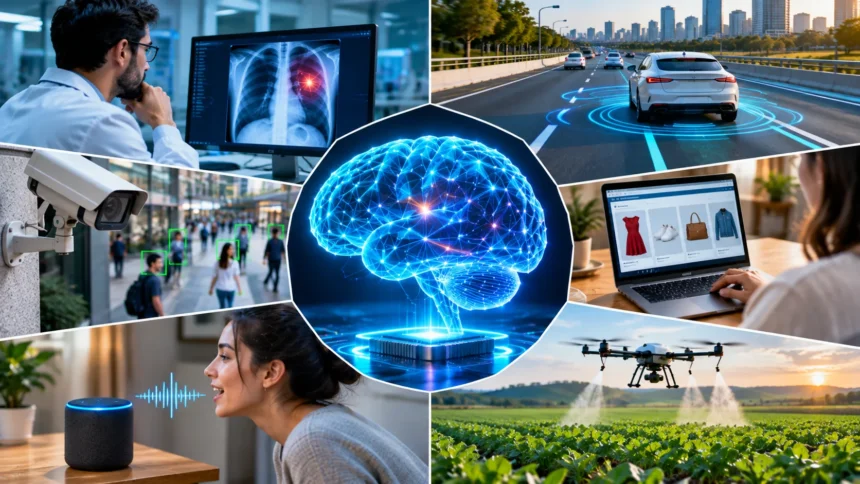
Deep learning is transforming how businesses, researchers, and technology companies solve complex problems. From recognizing objects in images to understanding human speech, deep learning systems can process large amounts of information and identify patterns that traditional software may struggle to detect. These capabilities have made deep learning an important part of modern artificial intelligence. Today, its applications extend across healthcare, finance, transportation, education, and many other industries.
Deep learning use cases include medical image analysis, fraud detection, language translation, recommendation systems, and automated quality inspection. These applications use artificial neural networks to learn patterns from data and support specific tasks. However, successful implementation depends on reliable information, appropriate technology, and careful human oversight. This guide explores practical deep learning examples, their benefits, limitations, and real-world applications.
What Is Deep Learning and How Does It Work?
Deep learning is a branch of machine learning that uses artificial neural networks containing multiple processing layers. These networks learn relationships within data by adjusting mathematical parameters during training. They can process different information types, including images, text, audio, and numerical records. This makes deep learning useful for tasks involving complicated patterns and large datasets.
During training, a deep learning model receives examples and produces predictions or other outputs. Its results are compared with suitable training objectives, and the model’s internal parameters are adjusted. Repeating this process helps the network learn useful representations. However, the effectiveness of training depends on data quality, model architecture, and available computing resources.
Different neural network architectures are suited to different applications. Convolutional neural networks are commonly associated with image processing, while transformer-based models are widely used for language and other sequence-related tasks. Specialized architectures also support audio, forecasting, and scientific analysis. Selecting the appropriate model depends on the problem rather than assuming one design works best everywhere.
Why Deep Learning Is Used in Real-World Applications
Deep learning is particularly useful when organizations need to analyze information that is difficult to process through simple programming rules. Images, spoken language, and unstructured documents contain complex patterns that may require advanced analytical methods. Neural networks can learn representations directly from appropriate training data. This reduces some manual feature engineering requirements.
Another advantage is the ability to support automation and large-scale data processing. A trained model may classify thousands of images or organize substantial document collections more efficiently than manual review. These capabilities can reduce repetitive work and assist employees with information-intensive tasks. However, automated results still require appropriate quality checks.
Deep learning is not necessarily the best solution for every problem. Traditional statistical models or simpler machine learning approaches may be more effective when datasets are small or highly structured. Neural networks can also require substantial resources. Organizations should compare available methods before choosing deep learning for a practical application.
Deep Learning in Healthcare and Medical Imaging
Healthcare provides several important examples of real-world deep learning applications. Neural networks can analyze medical images to identify patterns relevant to particular clinical tasks. Researchers and developers use these systems with X-rays, CT scans, MRI images, and other diagnostic information. Their purpose is often to assist healthcare professionals rather than replace medical expertise.
Deep learning models may help identify certain abnormalities or prioritize images requiring additional review. For example, a properly validated system can support the detection of specific findings in radiology images. However, accuracy depends on the condition, training data, and clinical environment. Medical applications require rigorous evaluation before being used in patient care.
Healthcare organizations also explore deep learning for clinical documentation and administrative analysis. Language models may assist with organizing medical notes or extracting relevant information from records. These applications can save time when implemented carefully. Patient privacy, clinical accuracy, and professional oversight remain essential because errors can affect important healthcare decisions.
Deep Learning Use Cases in Banking and Finance
Banks and financial institutions use deep learning to analyze complex transaction patterns and support fraud detection. Financial systems process large amounts of information, making automated analysis valuable in certain situations. Models can identify unusual activity that may deserve investigation. However, an unusual transaction does not necessarily indicate fraudulent behavior.
Deep learning can also support financial document processing and customer service operations. Language models may help classify documents, extract information, and organize routine inquiries. These capabilities can reduce administrative work when results meet appropriate accuracy standards. Sensitive financial information must be protected throughout data collection, processing, and storage.
Some financial organizations investigate deep learning for risk assessment and forecasting. Models may analyze historical information to estimate potential outcomes. However, financial markets and customer behavior can change unexpectedly, reducing prediction reliability. Organizations must consider fairness, transparency, regulations, and independent validation before using automated systems for consequential decisions.
Deep Learning in E-Commerce and Online Shopping
E-commerce platforms use deep learning to organize products, analyze customer interactions, and support personalized shopping experiences. Recommendation systems can identify relationships between products and browsing behavior. These systems may suggest items that match relevant interests. Their usefulness depends on the quality of information and the design of the recommendation process.
Image recognition provides another practical application in online shopping. Some platforms use computer vision to identify visually similar products or organize product images. Customers may search using photographs instead of entering exact product names. This can make large catalogs easier to explore, although results may not always match user expectations.
Retailers may also use deep learning to analyze product reviews and customer support messages. Language processing models can identify recurring complaints or categorize feedback. These findings may help improve services and product information. However, businesses should avoid excessive personal data collection and maintain transparency about relevant information practices.
Deep Learning Applications in Transportation
Transportation systems use deep learning to interpret complex information from cameras, sensors, and operational records. Computer vision models can help recognize road signs, vehicles, pedestrians, and other visual features. These capabilities contribute to research and development in driver assistance and automated transportation. However, real-world driving environments present substantial safety challenges.
Advanced driver assistance systems may use neural networks as part of their perception technology. These models analyze sensor information to support functions such as detecting objects or understanding road conditions. Their performance can vary with lighting, weather, and unusual situations. Drivers must follow the system’s operating instructions and remain attentive whenever supervision is required.
Deep learning also supports transportation planning and logistics analysis. Organizations may use predictive models to estimate demand, examine traffic patterns, or identify maintenance concerns. These applications can help improve operational decisions. However, forecasting results should be checked against actual conditions because transportation systems are affected by many changing factors.
Deep Learning in Manufacturing and Quality Control
Manufacturing companies use deep learning to identify visual defects and monitor certain production processes. Computer vision systems can examine product images for cracks, surface irregularities, or other specified characteristics. This may reduce the amount of repetitive visual inspection required. However, performance depends on image quality, lighting, and the types of defects represented during training.
Predictive maintenance is another important industrial application. Deep learning models can analyze sensor readings associated with equipment temperature, vibration, or operating behavior. Unusual patterns may indicate that a machine requires further inspection. These systems support maintenance planning but cannot guarantee that every mechanical failure will be predicted.
Manufacturers may also use deep learning to improve production analysis and process monitoring. Models can help identify relationships between operating conditions and product outcomes. These insights may guide further investigation or adjustments. Reliable implementation requires accurate data, technical expertise, and appropriate safety procedures before changes are made to industrial equipment.
Deep Learning Use Cases in Cybersecurity
Cybersecurity systems can use deep learning to identify suspicious patterns in network activity, software behavior, and security records. Large organizations generate substantial amounts of information that can be difficult to review manually. Neural networks may help classify events and prioritize alerts. These capabilities support security analysts working across complex digital environments.
Malware classification is one example of a cybersecurity application. A model may examine file characteristics or program behavior to identify patterns associated with malicious software. Deep learning can complement traditional detection methods in some situations. However, attackers can adapt their techniques, and automated systems may overlook new threats.
Deep learning is also used in research involving phishing detection and unusual account activity. Language and behavioral analysis may help identify certain suspicious events. Nevertheless, false alerts and incorrect classifications remain important limitations. Effective cybersecurity requires layered safeguards, trained professionals, regular updates, and clear incident response procedures.
Deep Learning in Speech Recognition and Voice Assistants
Speech recognition is one of the most familiar deep learning applications used in everyday technology. Neural networks analyze audio information to identify spoken words and produce text. These systems support voice assistants, automatic captions, and transcription software. They can make digital tools easier to use when typing is inconvenient or inaccessible.
Deep learning models learn relationships between acoustic patterns, pronunciation, and language context. Modern systems can support multiple languages and different speaking styles. However, recognition accuracy may decline with background noise, unfamiliar accents, or specialized vocabulary. Careful testing is important when transcription errors could create misunderstandings.
Audio processing also extends beyond ordinary speech recognition. Deep learning can help classify environmental sounds, analyze equipment noise, and support certain accessibility technologies. These applications depend on suitable recordings and clear objectives. Users should understand that automated audio interpretation can contain errors and may require manual verification.
Deep Learning in Natural Language Processing
Natural language processing allows computers to work with written and spoken language. Deep learning has improved applications involving translation, text classification, summarization, and question answering. Transformer-based models can learn relationships across sequences of words and other tokens. These capabilities support many modern language technologies.
Businesses use language processing systems to organize support requests, summarize documents, and identify themes in customer feedback. Researchers may analyze large collections of text to study patterns and extract information. These applications can improve efficiency when carefully implemented. However, models may misunderstand context or generate statements that are not supported by evidence.
Large language models are another practical example of deep learning. They can assist with writing, programming, explanations, and information organization. Their outputs may appear fluent even when details are incorrect. Human review remains important, particularly when content involves legal, medical, financial, or other consequential information.
Deep Learning Applications in Education
Educational technology uses deep learning to support certain learning and administrative activities. Language models may provide explanations, organize study materials, or help generate practice questions. These tools can make information more accessible when used appropriately. However, students and teachers should verify important content rather than assuming every automated explanation is accurate.
Some educational platforms explore personalized learning systems that respond to student progress. Models may analyze performance patterns and suggest suitable learning materials. These recommendations can help educators identify topics that deserve additional attention. Nevertheless, automated systems cannot fully understand every student’s learning needs or personal circumstances.
Deep learning may also assist with transcription, translation, and accessibility features in educational environments. Automatic captions can support access to recorded lessons, while language tools can help organize written information. These benefits depend on accurate implementation and responsible data handling. Teachers remain essential for providing guidance, context, and meaningful feedback.
Deep Learning in Agriculture and Farming
Agriculture offers practical deep learning use cases involving crops, soil conditions, and environmental monitoring. Computer vision models can analyze photographs of plants to identify visible characteristics or possible signs of disease. These systems may help farmers prioritize further inspection. However, image-based predictions should not replace appropriate agricultural expertise.
Satellite imagery and drone photographs can also provide information about fields and vegetation. Deep learning models may classify land cover or identify patterns associated with crop conditions. These applications help researchers and agricultural professionals analyze large geographical areas. Their effectiveness depends on image resolution, local conditions, and suitable training examples.
Deep learning can also contribute to agricultural forecasting and resource planning. Models may analyze weather observations, historical yields, and other relevant information. These predictions can support decisions about production and operations. However, agricultural outcomes remain influenced by unpredictable environmental and economic factors, making careful interpretation essential.
Deep Learning Use Cases in Entertainment and Media
Entertainment platforms use deep learning to recommend videos, music, and other digital content. Recommendation models examine relevant interaction patterns to suggest material that may interest users. These systems help organize extensive content libraries. However, personalized recommendations can be imperfect and may limit the variety of content people encounter.
Deep learning also supports media production through image processing, speech generation, and visual effects tools. Certain systems can help enhance images, generate subtitles, or assist creative workflows. These capabilities may reduce repetitive editing tasks. However, generated content can introduce accuracy, ownership, and authenticity concerns that require responsible handling.
Media organizations also use language models for document organization and content analysis. Automated systems may help categorize large collections of articles, transcripts, or recordings. Their value depends on reliable outputs and appropriate editorial review. Human professionals remain important for verifying information, making creative decisions, and maintaining ethical standards.
Deep Learning in Scientific Research
Scientific researchers use deep learning to analyze large and complicated datasets. Neural networks can identify patterns in images, measurements, simulations, and other forms of research information. These capabilities are useful when traditional analytical approaches become difficult to apply at scale. However, computational results still require scientific interpretation and validation.
Biological research provides important examples, including protein structure prediction and certain forms of molecular analysis. Deep learning systems can help researchers investigate relationships that would otherwise require extensive computational effort. These tools support scientific discovery but do not replace experimental evidence. Predictions should be evaluated using appropriate research methods.
Astronomy and environmental science also benefit from advanced pattern recognition. Researchers may use deep learning to classify astronomical images or analyze satellite observations. These applications can help organize substantial amounts of information. Their reliability depends on representative data, suitable model design, and careful comparison with established scientific findings.
Deep Learning for Image and Video Analysis
Image and video analysis is one of the strongest areas of practical deep learning development. Computer vision models can recognize objects, classify scenes, and identify specific visual patterns. These capabilities support applications across retail, transportation, manufacturing, and research. Their usefulness depends on how well the training data represents real operating conditions.
Video analysis introduces additional complexity because information changes across consecutive frames. Deep learning models may examine movement patterns or identify objects appearing throughout a recording. This can support certain traffic monitoring, industrial inspection, and media organization tasks. However, automated interpretations may become unreliable when visual conditions change.
Privacy is an important consideration when analyzing images and videos involving people. Organizations should follow applicable laws and limit unnecessary collection of personal information. Accuracy also matters because incorrect classifications can affect individuals and business decisions. Responsible use requires clear purposes, suitable safeguards, and appropriate human oversight.
Deep Learning in Weather and Climate Research
Weather and climate research involves analyzing complicated relationships between atmospheric, oceanic, and environmental conditions. Deep learning can help researchers process large datasets and identify useful statistical patterns. These techniques may complement traditional physical models and observational methods. However, they do not eliminate uncertainty in environmental predictions.
Some weather forecasting applications use machine learning architectures to predict atmospheric conditions from observational or modeled data. These approaches can provide computational advantages for certain forecasting tasks. However, performance varies across regions, forecast periods, and weather events. Researchers compare outputs with established benchmarks to determine their practical usefulness.
Climate researchers may also apply deep learning to satellite data, environmental classification, and analysis of historical patterns. These tools can support investigations involving temperature, precipitation, and land conditions. Long-term climate understanding still requires physical science and reliable observations. Deep learning serves as an analytical tool rather than a replacement for climate research methods.
Benefits and Limitations of Real-World Deep Learning
One major benefit of deep learning is its ability to learn complex patterns from suitable data. This supports applications involving images, language, audio, and other difficult information types. It can also reduce some repetitive work through automated analysis. These advantages make deep learning valuable when traditional approaches cannot meet practical requirements.
However, deep learning systems often require significant computing resources, reliable training data, and specialized technical knowledge. Their internal decision-making processes can also be difficult to interpret. Models may produce incorrect outputs when presented with unfamiliar conditions. These limitations become particularly important in applications involving safety, privacy, or consequential decisions.
Organizations should evaluate deep learning according to measurable outcomes rather than technical popularity. A simpler method may provide comparable results with fewer resources. When deep learning is appropriate, careful validation and monitoring help reduce operational risks. Understanding both strengths and limitations supports more effective technology investments.
Best Practices for Implementing Deep Learning
Successful deep learning projects begin with a clearly defined problem and realistic performance goals. Organizations should determine what information is available and whether neural networks offer advantages over simpler alternatives. A small evaluation project can help identify practical challenges. This reduces unnecessary investment before the technology’s usefulness has been demonstrated.
High-quality training data is essential for developing reliable models. Developers should consider accuracy, representativeness, privacy, and appropriate data preparation. Separate validation and testing procedures help evaluate performance beyond the examples used for training. These steps reduce the risk of drawing conclusions from misleading results.
Monitoring remains important after a deep learning system becomes operational. Data patterns, user behavior, and environmental conditions may change over time. Organizations should review model performance and investigate unexpected errors. Clear human oversight and responsible maintenance help ensure that applications continue supporting their intended purposes.
Conclusion
Deep learning use cases demonstrate how artificial intelligence can support practical tasks across many industries. Healthcare, finance, transportation, manufacturing, agriculture, and education all provide examples of neural networks being used to analyze complex information. Image recognition, language processing, and speech analysis are among the most familiar applications. Their value comes from solving specific problems rather than simply introducing advanced technology.
The benefits of deep learning include pattern recognition, automatic feature extraction, and the ability to process large amounts of unstructured information. However, these capabilities also introduce challenges involving data quality, computing costs, transparency, and reliability. Successful applications require careful evaluation and appropriate human involvement. Deep learning should complement professional expertise rather than replace critical judgment.
As technology continues developing, deep learning may support additional applications in research, business, and everyday services. Organizations should focus on measurable results, responsible data handling, and ongoing performance monitoring. Understanding real-world examples helps explain where deep learning can provide meaningful improvements. The most effective applications balance technical capabilities with practical requirements and realistic expectations.
Frequently Asked Questions (FAQs)
What Are the Most Common Deep Learning Use Cases?
Common deep learning use cases include image recognition, speech processing, fraud detection, recommendation systems, medical image analysis, and language translation. These applications use neural networks to recognize patterns in complex data.
How Is Deep Learning Used in Everyday Life?
Deep learning supports voice assistants, automatic captions, online recommendations, image recognition, and translation tools. Many people use these technologies through smartphones, websites, and digital services without directly interacting with the underlying models.
How Is Deep Learning Used in Healthcare?
Deep learning can assist with medical image analysis, clinical documentation, and certain research tasks. However, healthcare applications require careful testing, privacy protection, and professional oversight to support safe decisions.
What Industries Benefit Most From Deep Learning?
Healthcare, finance, retail, manufacturing, transportation, and technology are major areas of deep learning adoption. Benefits depend on data quality, implementation costs, and whether the models solve meaningful operational problems.
What Are the Main Limitations of Deep Learning?
Deep learning can require substantial training data, computing resources, and specialized expertise. Models may also produce incorrect or biased results, making validation, monitoring, and human oversight important.