
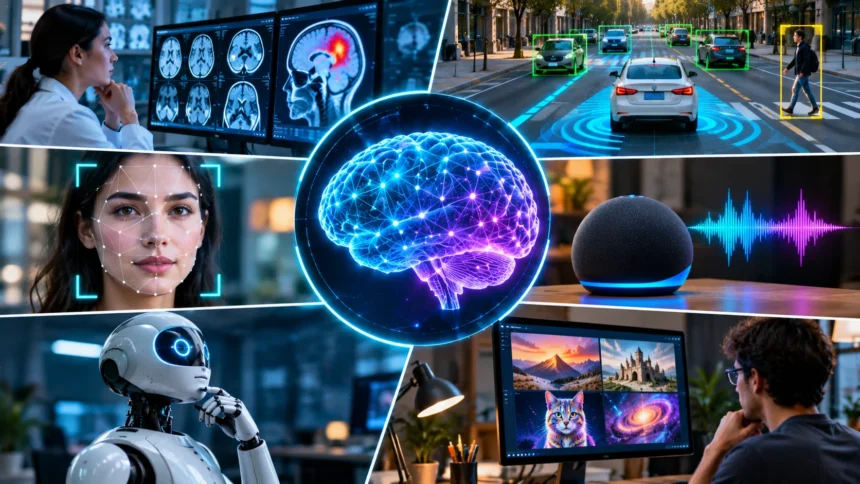
Deep learning is changing how computers recognize patterns, process information, and perform complex tasks. From smartphone cameras to medical imaging systems, this technology powers many tools that people use every day. Understanding real-world deep learning examples makes it easier to see how artificial intelligence works beyond technical explanations.
Unlike traditional computer programs that depend mainly on predefined instructions, deep learning systems learn patterns from data. They use artificial neural networks with multiple layers to recognize images, understand speech, generate text, and make predictions. These capabilities have created opportunities across healthcare, education, transportation, finance, and entertainment.
You do not need a background in programming to understand how these applications work. Learning about practical examples helps explain both the capabilities and limitations of neural networks. This guide explores important deep learning use cases, their benefits, and the challenges involved in applying this technology to real problems.
What Is Deep Learning?
Deep learning is a branch of machine learning that uses artificial neural networks with multiple layers to process information. These networks learn relationships within data through repeated training. They can identify complex patterns in images, text, audio, and numerical information without requiring developers to manually define every feature.
The term “deep” refers to the multiple computational layers within a neural network. Each layer transforms the information it receives and passes the result to another layer. Through this process, a model can learn representations that help it recognize objects, generate language, or estimate future outcomes.
Deep learning is especially useful for problems involving large amounts of complicated information. However, its success depends on training data, model architecture, and careful testing. Looking at practical applications provides a clearer understanding of when this technology is valuable and where its limitations become important.
How Deep Learning Works in Real-World Applications
Deep learning systems begin by processing information through interconnected layers of artificial neurons. Each layer performs mathematical calculations using adjustable parameters called weights and biases. These calculations transform the input into outputs that support tasks such as classification, prediction, recognition, or content generation.
During training, the model learns from examples and a defined learning objective. An optimization algorithm adjusts its parameters to improve performance based on feedback from a loss function. This process repeats many times until the model develops useful patterns for handling the intended task.
After training, the model can process new information through a process called inference. For example, an image recognition system can analyze an unfamiliar photograph and predict what it contains. The reliability of that prediction depends on how well the training examples represent real operating conditions.
Deep Learning Example: Facial Recognition
Facial recognition is a familiar example of deep learning in computer vision. Neural networks can analyze patterns in facial images and create numerical representations of distinguishing visual features. These representations may help a system compare a face with previously enrolled images under suitable conditions.
Some smartphones use facial authentication to help verify whether the person attempting access matches an enrolled user. Depending on the device, the system may combine specialized sensors with machine learning techniques. Its performance depends on hardware, lighting conditions, enrollment quality, and the security measures included in the implementation.
Facial recognition also raises important concerns involving privacy, consent, and accuracy across different populations. False matches and identification errors can have serious consequences in sensitive settings. Organizations using this technology need appropriate safeguards, careful evaluation, and clear policies governing how biometric information is collected and handled.
Deep Learning Example: Self-Driving Cars
Autonomous driving research uses deep learning to help vehicles interpret information about surrounding environments. Cameras and other sensors provide data about roads, traffic signals, pedestrians, and nearby vehicles. Neural networks can support object detection, lane recognition, and prediction of movement around the vehicle.
For example, a perception model may identify pedestrians approaching a crossing or classify road markings in changing conditions. Other systems can estimate how nearby vehicles might move. These outputs may contribute to larger driving systems that combine perception with planning, control, and additional safety mechanisms.
However, deep learning alone does not make a vehicle capable of safe autonomous operation. Weather, unusual road situations, and unexpected behavior create difficult challenges. Real-world driving systems require extensive testing, reliable hardware, operational restrictions, and appropriate human or automated supervision.
Deep Learning Example: Voice Assistants
Voice assistants use deep learning to process spoken requests and support natural interactions with digital devices. Speech recognition models convert audio signals into text or other internal representations. Language processing components then help interpret requests and determine suitable responses or actions.
For example, a user might ask a voice assistant to set an alarm or provide information. The system processes the spoken words and identifies the intended task. Depending on its design, it may combine neural networks with conventional software to complete the requested action.
Speech recognition has improved through advances in neural network training and audio processing. However, background noise, unfamiliar accents, and unclear speech can still affect accuracy. Voice assistants also require careful privacy controls because audio interactions may contain personal information.
Deep Learning Example: Language Translation
Language translation is an important deep learning application that helps people communicate across different languages. Neural machine translation models learn relationships between words, phrases, and broader sentence structures. These systems can generate translated text while considering context rather than translating every word independently.
For example, a translation tool may process an English sentence and generate an equivalent sentence in another language. Transformer-based architectures are commonly used for this task. Their attention mechanisms help represent relationships between different parts of the text during translation.
Translation quality depends on language availability, training data, and the complexity of the original message. Idioms, cultural references, and specialized terminology can create difficulties. For important legal, medical, or professional documents, human review remains valuable even when automated translation appears fluent.
Deep Learning Example: Medical Image Analysis
Medical image analysis demonstrates how deep learning can assist healthcare professionals with complex visual information. Neural networks can examine X-rays, scans, and other medical images to identify patterns associated with particular conditions. These systems are generally designed to support clinical workflows rather than replace professional judgment.
For example, researchers develop image classification and detection models that highlight potentially important findings in medical scans. Such tools may help professionals prioritize reviews or examine specific image regions. Their usefulness depends on the clinical task, validation results, and integration into existing healthcare processes.
Medical applications require especially careful testing because errors can affect patient care. Training datasets must represent relevant populations and imaging conditions. Regulatory requirements, patient privacy, and clinician oversight are also essential considerations before deploying deep learning systems in healthcare settings.
Deep Learning Example: Chatbots and Virtual Assistants
Modern chatbots are among the most recognizable applications of deep learning in natural language processing. Large language models learn statistical relationships from extensive training data. They can generate responses, answer questions, summarize information, and assist with writing or other language-based tasks.
For example, a customer support chatbot may explain product features or help users navigate common service questions. More advanced systems can work with business information and connected tools when appropriately configured. Their usefulness depends on access to relevant information and clear boundaries around automated actions.
Despite their conversational abilities, chatbots can produce incorrect or misleading answers. They may misunderstand requests or generate details that are not supported by reliable information. Effective applications use testing, safeguards, human escalation, and verification processes when mistakes could have meaningful consequences.
Deep Learning Example: Recommendation Systems
Recommendation systems help platforms suggest products, videos, music, or other content that users may find relevant. Deep learning models can identify complex relationships between user interactions and available items. These relationships support predictions about which recommendations may match particular interests.
For example, a streaming service may consider viewing history, content characteristics, and interaction patterns when suggesting entertainment. An online shopping platform might use related techniques to recommend products. Deep learning is often combined with other recommendation algorithms and business rules to improve relevance.
Recommendation quality depends on data availability, feedback signals, and the system’s objectives. Poorly designed systems may repeatedly suggest similar content or overlook less popular options. Responsible recommendation design also considers user control, privacy, and the risk of encouraging excessive engagement.
Deep Learning Example: Fraud Detection in Banking
Financial institutions use machine learning, including deep learning, to help detect suspicious transaction patterns. Neural networks can analyze relationships between transaction details and historical activity. These models may identify unusual behavior that deserves additional investigation by security or fraud prevention teams.
For example, a fraud detection system might flag a transaction that differs significantly from established account activity. The model may consider multiple relevant signals rather than relying on a single rule. However, a flagged transaction does not automatically prove that fraudulent activity has occurred.
Financial fraud systems must balance detection performance with the inconvenience caused by false alerts. Changes in customer behavior and evolving fraud patterns can also reduce model effectiveness. Regular evaluation, appropriate security controls, and human review remain important for dependable financial applications.
Deep Learning Example: Image Generation
Image generation is a creative application of deep learning that produces new visual content from learned patterns. Generative models can create illustrations, realistic-looking scenes, and other images based on text descriptions or visual inputs. Their capabilities depend on the architecture, training process, and available controls.
For example, a designer might describe a fictional landscape and use a generative image system to explore possible visual concepts. Similar tools can support brainstorming, advertising mockups, and creative experimentation. The generated results may still require editing to match specific requirements.
Image generation also creates questions involving copyright, authenticity, and misleading visual content. Generated images can contain inaccurate details or reflect biases present in training data. Responsible use involves respecting intellectual property, protecting personal privacy, and clearly communicating when synthetic imagery could be mistaken for real evidence.
Deep Learning Example: Speech-to-Text Technology
Speech-to-text systems convert spoken language into written text using automatic speech recognition. Deep learning models analyze audio patterns and predict the words or tokens associated with those sounds. This technology supports transcription, accessibility tools, meeting notes, and voice-controlled software.
For example, a student might use transcription software to create notes from a recorded lecture when recording is permitted. A business may use a similar system to prepare a draft meeting transcript. The resulting text can then be reviewed and corrected for accuracy.
Recognition performance varies according to microphone quality, background noise, speaking style, and language support. Specialized terminology and overlapping conversations can introduce errors. Sensitive recordings also require appropriate consent and data protection, particularly when processed through online services.
Deep Learning Example: Email Spam Detection
Email providers use machine learning techniques to identify messages that may contain spam, phishing attempts, or other suspicious content. Deep learning can help analyze language patterns and relationships between message features. These models may work alongside reputation systems, authentication checks, and established security rules.
For example, a spam detection system may examine unusual wording or message characteristics that resemble previously identified threats. It can assign a risk score and help determine whether a message requires filtering. The system may also learn from appropriately collected feedback about incorrect classifications.
No filtering system can identify every harmful message or avoid every false positive. Attackers continually change their methods, making updates and monitoring necessary. Users should still review unexpected requests carefully and avoid assuming that every message reaching their inbox is trustworthy.
Deep Learning Example: Predictive Maintenance
Predictive maintenance uses data analysis to estimate when equipment may require inspection or repair. Deep learning models can examine sensor readings, operational histories, and other measurements to identify patterns linked to equipment performance. This approach may help organizations plan maintenance more effectively.
For example, a manufacturing facility might monitor vibration, temperature, and operating conditions across industrial machines. A trained model could identify unusual patterns associated with developing mechanical problems. Maintenance teams can then investigate the equipment before deciding whether repairs are necessary.
Predictive maintenance depends on reliable sensors, representative historical data, and suitable operating conditions. Unexpected failures may still occur, and unusual readings do not always indicate damage. The technology works best as part of a broader maintenance strategy that includes professional inspections.
Deep Learning Example: Agriculture and Crop Monitoring
Agriculture provides practical opportunities for deep learning through image analysis and sensor-based monitoring. Neural networks can examine photographs of crops, soil conditions, and agricultural environments. These models may help identify plant diseases, estimate crop characteristics, or monitor changes across growing areas.
For example, an image classification system might analyze leaf photographs to identify patterns associated with plant disease. Drone imagery can also support selected crop monitoring applications. Farmers and agricultural specialists may use these outputs alongside field observations to make more informed decisions.
Agricultural models must account for changing weather, soil conditions, plant varieties, and image quality. A system trained in one region may not perform equally well elsewhere. Reliable deployment requires local validation and continued involvement from people with agricultural expertise.
Deep Learning Example: Manufacturing Quality Control
Manufacturing companies use computer vision systems to inspect products and identify possible defects. Deep learning models can analyze images from production lines and recognize patterns associated with surface damage or manufacturing inconsistencies. Automated inspection can support quality control when properly designed and evaluated.
For example, a neural network may examine product photographs and flag items with unusual visual features. Human inspectors can review uncertain cases before making final decisions. This combination can help organizations manage repetitive inspection tasks while maintaining appropriate oversight.
Successful quality control systems require consistent imaging conditions and representative examples of acceptable and defective products. Changes in materials, lighting, or equipment may affect performance. Manufacturers must evaluate false detections and missed defects before depending on automated inspection outputs.
Deep Learning Example: Cybersecurity Threat Detection
Cybersecurity systems can use deep learning to analyze complex patterns in digital activity. Models may examine network traffic, system logs, or other security information to identify potentially unusual behavior. These capabilities can support security teams responsible for monitoring large and changing computing environments.
For example, an anomaly detection model might highlight activity that differs from established network patterns. Security analysts can investigate the alert and determine whether it represents a genuine threat. Deep learning may complement established detection rules rather than replacing other protective measures.
Cybersecurity models face challenges because attackers continually adapt their techniques. Unusual behavior may also result from legitimate software changes or normal business activity. Effective systems require updated data, careful evaluation, layered defenses, and trained professionals who can interpret alerts.
Deep Learning Example: Personalized Education
Educational technology can use deep learning to support personalized learning experiences and analyze student interactions. Models may help identify patterns in practice results and suggest relevant exercises. These features can assist educators when they are designed around clear educational objectives.
For example, a learning platform might recommend additional practice after a student repeatedly struggles with a particular concept. Language learning applications can also use speech recognition to provide pronunciation feedback. Such tools offer supplementary support rather than a complete replacement for instruction.
Personalized learning systems need careful attention to accuracy, fairness, and student privacy. A model’s prediction should not permanently label a learner’s abilities or restrict educational opportunities. Teachers remain important for interpreting progress, understanding individual needs, and providing meaningful feedback.
Benefits of Deep Learning in Different Industries
Deep learning can help organizations process complex information that would be difficult to analyze using manually written rules alone. Neural networks are especially useful for certain visual, audio, and language tasks. Their ability to learn representations from data makes them adaptable across different applications.
Another benefit is the potential to automate selected repetitive processes and support faster analysis. Image inspection, document classification, and speech transcription provide practical examples. However, efficiency improvements depend on reliable implementation and should be measured against the costs of developing and operating the system.
Pretrained models can also make advanced capabilities more accessible to smaller development teams. Transfer learning allows organizations to adapt existing networks to related tasks. This may reduce the need for extensive training resources, although compatibility, licensing, privacy, and evaluation still require attention.
Challenges of Using Deep Learning in Real Life
Deep learning systems often require substantial training data and computational resources. Complex networks may need specialized hardware, storage, and ongoing maintenance. Organizations must consider whether expected benefits justify these costs before selecting a deep learning solution.
Another challenge involves the quality and fairness of model predictions. Training data may contain errors, gaps, or patterns that do not represent real-world conditions. As a result, models can produce unreliable outputs or perform differently across user groups and environments.
Interpretability, privacy, and security are also important considerations. Some neural networks are difficult to explain, especially when making complex predictions. Responsible deployment requires clear performance standards, appropriate safeguards, regular monitoring, and human oversight when automated decisions could have significant consequences.
How Beginners Can Explore Deep Learning Examples
Beginners can start by experimenting with simple image classification and text recognition projects. These activities demonstrate how neural networks process information and make predictions. Small datasets and pretrained models provide accessible opportunities to explore the technology without building a complex system from scratch.
Learning basic Python programming can make practical experimentation easier. Frameworks such as PyTorch and TensorFlow offer tools for creating and evaluating neural networks. Beginner-friendly projects often include handwritten digit recognition, basic sentiment classification, and image categorization.
As your understanding develops, compare how different models approach similar problems. Pay attention to training data, prediction accuracy, and potential errors rather than focusing only on successful results. This practical approach builds a stronger understanding of how deep learning applications work in real environments.
Conclusion
Deep learning examples demonstrate how artificial neural networks support a wide range of modern technologies. Applications such as image recognition, voice assistants, language translation, and medical image analysis show how models process complex information. These examples make the practical value of deep learning easier to understand.
Businesses and researchers also use deep learning in fraud detection, manufacturing, agriculture, cybersecurity, and predictive maintenance. Each application has different requirements for training data, accuracy, and operational reliability. The technology offers important opportunities, but its performance depends on careful development and evaluation.
Understanding real-world applications is a useful starting point for learning about artificial intelligence. Begin with familiar examples, explore the basic concepts behind neural networks, and examine both successful results and limitations. This balanced approach helps explain where deep learning provides meaningful value and where other solutions may be more appropriate.
Frequently Asked Questions
What are the most common examples of deep learning?
Common deep learning examples include facial recognition, speech-to-text systems, language translation, chatbots, and image classification. Neural networks also support selected applications in healthcare, finance, transportation, and manufacturing.
How is deep learning used in everyday life?
Deep learning supports features such as smartphone photography, voice assistants, automated captions, and personalized recommendations. These applications use trained neural networks to recognize patterns, process information, and generate useful outputs.
Is ChatGPT an example of deep learning?
Yes, ChatGPT uses large language models based on deep learning technology. These models learn relationships in training data and generate responses using neural network architectures designed to process language.
What is a simple deep learning project for beginners?
Handwritten digit recognition is a popular beginner project. A neural network learns from labeled images of numbers and then predicts which digit appears in a new image.
Which industries benefit most from deep learning?
Deep learning can benefit healthcare, finance, manufacturing, transportation, education, and technology. Its usefulness depends on the problem, available data, implementation costs, and whether the model provides reliable improvements over simpler methods.