

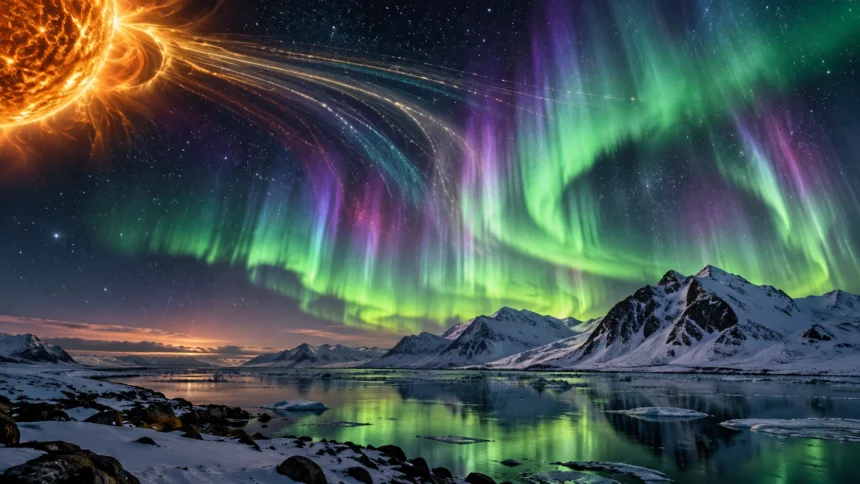
The Northern Lights are among the most beautiful natural displays on Earth. They appear as glowing curtains of green, pink, purple, and red light moving across the night sky. People have admired these colorful displays for thousands of years, often wondering what creates their unusual shapes and colors. Today, scientists understand that the Northern Lights result from an interaction between particles from the Sun, Earth’s magnetic field, and gases in our atmosphere.
What Are the Northern Lights?
The Northern Lights, scientifically known as Aurora Borealis, are colorful light displays that appear in the skies of Earth’s northern regions. They occur when energetic particles interact with gases high in the atmosphere. These interactions release energy in the form of visible light. The result is a beautiful display of glowing colors that can change shape and brightness within seconds.
Northern Lights commonly appear in high-latitude locations such as Norway, Iceland, Finland, Canada, and Alaska. These regions are closer to Earth’s northern magnetic pole, where auroral activity frequently occurs. However, strong solar activity can sometimes make the lights visible much farther south. Their appearance depends on solar conditions, atmospheric activity, and the observer’s location.
The Northern Lights are not clouds, reflections, or artificial lights produced by human activity. They are natural atmospheric phenomena connected to the Sun and Earth’s magnetic environment. Scientists study auroras to understand space weather and the movement of charged particles. Their research also helps explain how solar activity affects our planet.
What Causes the Northern Lights to Appear?
The Northern Lights begin with activity occurring approximately 150 million kilometers away on the Sun. Our star continuously releases a stream of charged particles known as the solar wind. These particles travel through space and interact with Earth’s magnetic field. Under suitable conditions, energy from this interaction powers the glowing displays we observe.
Earth’s magnetic field acts as a protective barrier against many charged particles arriving from space. However, interactions between the solar wind and the magnetosphere can transfer energy into Earth’s magnetic environment. This energy helps accelerate particles toward the polar atmosphere. When these particles reach the upper atmosphere, they can produce colorful auroral light.
The intensity of the Northern Lights depends partly on how much energy enters Earth’s magnetic system. Strong solar disturbances can create brighter and more widespread auroral displays. During quiet periods, the lights may appear faint or remain limited to higher latitudes. This explains why auroral activity changes from one night to another.
How Does the Sun Create the Northern Lights?
The Sun is constantly active, releasing energy and charged particles into space. Its outer atmosphere, called the corona, is extremely hot and extends millions of kilometers outward. Charged particles escape from this region as the solar wind. These particles travel throughout the solar system and can influence planets with magnetic fields.
Sometimes, the Sun produces sudden eruptions known as coronal mass ejections, or CMEs. These events release enormous clouds of magnetized plasma into space. When a CME reaches Earth under favorable magnetic conditions, it can disturb the magnetosphere. Such disturbances may trigger geomagnetic storms and increase the chances of seeing powerful auroras.
Solar flares are another important form of solar activity, but they differ from coronal mass ejections. Flares release intense electromagnetic radiation, while CMEs carry large amounts of plasma and magnetic field. Both can contribute to space weather disturbances through different processes. Understanding these events helps scientists predict when unusually strong Northern Lights might occur.
How Does Earth’s Magnetic Field Produce Auroras?
Earth behaves somewhat like a giant magnet surrounded by an invisible magnetic field. This field extends far into space and forms a protective region called the magnetosphere. It helps redirect many charged particles from the solar wind. Without this magnetic environment, Earth’s interaction with energetic particles would be very different.
When the solar wind interacts with the magnetosphere, it can transfer energy into Earth’s magnetic system. Some particles become accelerated and travel along magnetic field lines toward polar regions. These particles collide with atmospheric gases and transfer energy to them. The excited gases eventually release that energy as light, producing auroras.
This magnetic process explains why Northern Lights are most common near the polar regions. Earth’s magnetic field guides many energetic particles toward areas surrounding the magnetic poles. However, the auroral zone can expand during powerful geomagnetic storms. As a result, people living farther from the Arctic may occasionally witness these colorful displays.
Why Do the Northern Lights Glow in Different Colors?
The Northern Lights glow because energetic particles transfer energy to atoms and molecules in Earth’s upper atmosphere. These particles excite the atmospheric gases, temporarily increasing their energy. When the excited gases return to lower-energy states, they can release photons of visible light. Different gases and energy transitions produce different colors.
Oxygen is responsible for many of the green and red colors seen in auroras. Green light commonly appears when excited oxygen atoms release energy at heights around 100 to 150 kilometers. Red auroras often develop at higher altitudes, where atmospheric conditions allow different oxygen emissions. The exact colors depend on the energy and environment involved.
Nitrogen contributes to blue, violet, and some pinkish auroral colors. These shades can appear when energetic particles interact with nitrogen molecules or their ions. Different colors may overlap, creating colorful curtains and unusual patterns. The combination of atmospheric gases, altitude, and particle energy makes every auroral display slightly different.
Why Are Green Northern Lights the Most Common?
Green is the color most frequently associated with the Northern Lights. This happens because oxygen atoms can produce strong green emissions under conditions commonly found in the auroral atmosphere. The resulting light is often bright enough to be visible to the human eye. It may appear as glowing arcs, curtains, or moving bands.
Green auroras commonly form at altitudes of roughly 100 to 150 kilometers above Earth’s surface. At these heights, energetic particles frequently excite oxygen atoms in ways that produce green light. The surrounding atmospheric conditions also support this emission. These factors help explain why green dominates many auroral photographs and observations.
The human eye is relatively sensitive to green light, which can make bright green auroras easier to notice. However, faint auroras may appear grayish or nearly colorless in darkness. Cameras can capture more color during longer exposures than our eyes detect. This is why photographs sometimes show vivid green lights that look much weaker in person.
What Causes Red, Purple, and Pink Northern Lights?
Red Northern Lights are usually associated with oxygen emissions occurring at relatively high altitudes. In the thin upper atmosphere, excited oxygen atoms can remain energized long enough to release red light. These emissions often form above lower green auroras. Red displays may become especially noticeable during strong geomagnetic storms.
Purple and violet auroras are commonly linked to nitrogen molecules and nitrogen ions. Their emissions can occur at different heights depending on the energy of incoming particles. These colors may appear along the lower edges of auroral curtains. They can also become more noticeable in photographs taken with sensitive cameras.
Pink Northern Lights often result from overlapping emissions, including colors produced by nitrogen and oxygen. Their exact appearance depends on the mixture of light reaching an observer or camera. Pink and purple shades may look especially dramatic during active auroral events. Together, these colors create some of the most striking displays in the night sky.
Why Do the Northern Lights Move and Change Shape?
The Northern Lights often resemble moving curtains, waves, or ribbons stretching across the sky. Their movement is connected to changing patterns of energetic particles entering Earth’s atmosphere. As magnetic conditions change, the location and intensity of particle precipitation also shift. These changes create the appearance of flowing or dancing light.
Auroral shapes can develop along magnetic field lines that guide charged particles into the atmosphere. When particle energy and magnetic activity vary, bright sections can appear, disappear, or move rapidly. Some displays form long arcs across the horizon. Others create twisting curtains, rays, and circular patterns resembling crowns.
Strong auroral activity can cause dramatic changes over just a few minutes. Bright structures may expand across the sky before slowly fading away. Scientists monitor these movements to investigate how energy travels through Earth’s magnetic environment. The changing shapes also reveal how dynamic the connection between the Sun and Earth can be.
Where Can You See the Northern Lights?
The Northern Lights are most frequently visible in regions located near the Arctic auroral zone. Popular viewing destinations include northern Norway, Finnish Lapland, Iceland, northern Sweden, Alaska, and parts of Canada. These areas often experience auroral activity during dark nights. However, clear skies and favorable solar conditions are still necessary.
Locations farther south may also experience Northern Lights during strong geomagnetic storms. Such events can expand the auroral zone beyond its usual boundaries. People who rarely see auroras may occasionally observe faint red or green glows near the northern horizon. The exact visibility depends on the storm’s strength and local viewing conditions.
Choosing a dark location away from city lights can greatly improve the viewing experience. Artificial lighting makes faint auroras harder to recognize, especially near the horizon. Open landscapes with an unobstructed northern view can also help. Even in favorable locations, however, auroral sightings are never guaranteed on a particular night.
When Is the Best Time to See the Northern Lights?
The best time to observe the Northern Lights is generally during dark, clear nights in high-latitude regions. In many northern destinations, the viewing season extends from approximately September through March or April. Longer winter nights provide more opportunities to notice auroral activity. However, the lights themselves can occur during other seasons.
Northern Lights are often observed during the hours surrounding local midnight, although they can appear earlier or later. Their timing depends on geomagnetic activity rather than a fixed daily schedule. Strong displays may begin suddenly and continue for several hours. Checking local aurora forecasts can help identify nights with favorable viewing conditions.
Weather also plays an important role in successful aurora viewing. Thick clouds can completely block the lights even when strong auroral activity occurs above them. A clear sky provides a much better opportunity to enjoy the display. Travelers should consider cloud forecasts, darkness, and solar activity when planning an aurora-watching trip.
How Do Scientists Predict the Northern Lights?
Scientists predict auroral activity by monitoring the Sun and changes in Earth’s magnetic environment. Specialized spacecraft measure solar wind speed, particle density, and the direction of the interplanetary magnetic field. These measurements help researchers estimate how solar conditions may affect Earth. Forecasts become more useful when combined with observations from ground-based instruments.
One commonly used measure of global geomagnetic activity is the Kp index. It ranges from 0 to 9, with higher values generally indicating more disturbed geomagnetic conditions. Higher Kp values can suggest that auroras may become visible at lower latitudes. However, local visibility also depends on darkness, cloud cover, and the observer’s position.
Aurora forecasting is challenging because space weather changes rapidly. Scientists can identify some solar eruptions before their effects reach Earth, but exact timing and intensity remain uncertain. Short-term forecasts often improve once spacecraft measure solar wind conditions near Earth. This information helps observers identify periods when auroral activity may increase.
What Is the Difference Between Northern and Southern Lights?
The Northern Lights occur around Earth’s northern polar region and are called Aurora Borealis. Similar light displays also occur around the southern polar region, where they are known as Aurora Australis. Both phenomena result from interactions involving energetic particles, atmospheric gases, and Earth’s magnetic field. Their underlying physical processes are closely related.
Northern and Southern Lights can display similar colors, including green, red, violet, and pink. They may also form comparable curtains, arcs, and moving patterns. However, the two displays are not always perfectly identical. Differences in magnetic field geometry and conditions within the magnetosphere can affect their appearance.
Southern Lights are often more difficult for travelers to observe because much of the southern auroral zone lies over Antarctica and surrounding oceans. Some displays can be seen from Tasmania, southern New Zealand, and occasionally other southern locations. The Northern Lights are generally more accessible because several populated regions lie within or near the northern auroral zone.
How Do Solar Storms Affect the Northern Lights?
Solar storms can greatly increase the brightness and geographic reach of Northern Lights. When strong disturbances interact with Earth’s magnetic environment, they may transfer substantial energy into the magnetosphere. This can intensify auroral activity and expand the regions where lights are visible. Some storms produce remarkable displays across unusually large areas.
Geomagnetic storms are often associated with Earth-directed coronal mass ejections. Certain high-speed solar wind streams can also disturb Earth’s magnetic field. The strength of the response depends on several factors, including the direction of the solar wind’s magnetic field. Not every solar eruption creates a major auroral display on Earth.
Strong geomagnetic storms can also affect technological systems. They may interfere with radio communication, satellite operations, and some navigation services. Under severe conditions, they can create problems for electrical power networks. Scientists monitor space weather to understand these risks and provide warnings to operators of vulnerable infrastructure.
Can the Northern Lights Be Seen From Space?
Yes, the Northern Lights can be observed from space, including from the International Space Station. Astronauts sometimes see glowing bands of light stretching along Earth’s curved horizon. These displays reveal the enormous scale of auroral activity. From orbit, the lights can appear as colorful structures surrounding parts of the polar regions.
Space-based observations provide a perspective that is difficult to obtain from the ground. Satellites can monitor large auroral regions and measure changes in their brightness and location. Specialized instruments also study emissions at wavelengths outside normal human vision. These observations help scientists investigate the relationship between auroras and Earth’s magnetic environment.
Photographs taken from space often show auroras glowing above Earth’s lower atmosphere. Their position highlights how high these displays occur compared with ordinary weather clouds. Scientists combine satellite images with ground measurements to study auroral behavior. Together, these observations provide a more complete picture of how auroras form and change.
Do Other Planets Have Northern Lights?
Earth is not the only planet in our solar system that experiences auroras. Jupiter, Saturn, Uranus, and Neptune have auroral activity associated with their magnetic environments. Their displays can differ significantly from those on Earth. Scientists study these differences to understand how charged particles interact with planetary atmospheres.
Jupiter produces particularly powerful auroras because of its strong magnetic field and complex particle environment. Its moon Io also contributes material that influences Jupiter’s magnetosphere. Many of Jupiter’s auroral emissions are detected in ultraviolet wavelengths. These observations reveal energetic processes that are different from typical auroral activity on Earth.
Auroras have also been detected on Mars, even though it lacks a strong global magnetic field like Earth’s. Localized magnetic regions and other interactions can produce auroral emissions in its atmosphere. Studying auroras across different planets helps researchers understand planetary magnetic fields. It also provides useful information about atmospheric behavior throughout the solar system.
Are the Northern Lights Dangerous to Humans?
Watching the Northern Lights from Earth’s surface is generally safe. The colorful glow itself does not release dangerous amounts of radiation toward people standing outdoors. Auroras occur high above the ground, where energetic particles interact with the atmosphere. Earth’s magnetic field and atmosphere provide important protection from many space-related hazards.
However, the geomagnetic storms associated with strong auroral activity can affect certain technologies. Satellites, navigation systems, and electrical infrastructure may experience disturbances during significant space weather events. Astronauts and some high-altitude aviation operations can face additional radiation concerns. These risks arise from the wider space weather environment rather than from visible auroral light.
People traveling to see the Northern Lights should focus on ordinary outdoor safety. Arctic destinations can experience extremely cold weather, icy surfaces, and rapidly changing conditions. Wearing suitable clothing and following local weather guidance is important. With sensible preparation, aurora watching can be an enjoyable way to experience a remarkable natural phenomenon.
Why Are the Northern Lights Important to Science?
The Northern Lights provide scientists with valuable information about Earth’s magnetic field and upper atmosphere. Their brightness, location, and movement reveal how energetic particles travel through the magnetosphere. Researchers use these observations to investigate the interaction between the Sun and Earth. This research improves our understanding of space weather.
Auroral studies also help scientists understand how energy enters and moves through Earth’s magnetic environment. Ground-based cameras, radar systems, satellites, and magnetic instruments provide complementary measurements. By comparing these observations, researchers can test scientific models of geomagnetic activity. Better models support more accurate explanations of auroral behavior.
Understanding auroras also has practical benefits for modern technology. Space weather research helps identify conditions that may disrupt satellites, communication systems, and power networks. Studying auroral events improves scientific knowledge of these disturbances. The Northern Lights therefore offer both a spectacular natural display and a useful window into the physics of near-Earth space.
Conclusion
The Northern Lights occur when energy from the Sun interacts with Earth’s magnetic environment and accelerates particles toward the polar atmosphere. These particles excite oxygen and nitrogen, causing them to release visible light. Different gases and atmospheric conditions produce the beautiful green, red, purple, and pink colors seen across the night sky.
The brightness, movement, and location of auroras depend on solar activity, geomagnetic conditions, and atmospheric processes. Strong solar storms can create especially impressive displays that reach beyond the Arctic. Although scientists understand the main processes behind auroras, predicting their exact appearance remains challenging.
The Northern Lights are more than a beautiful nighttime attraction. They help researchers understand the Sun, Earth’s magnetic field, and the effects of space weather on modern technology. As scientific instruments continue to improve, these glowing displays will reveal even more about the fascinating relationship between our planet and the Sun.
Frequently Asked Questions
What is the main cause of the Northern Lights?
The Northern Lights are caused by energetic particles interacting with gases in Earth’s upper atmosphere. Energy transferred from the solar wind into Earth’s magnetic environment drives the process, producing colorful light around the polar regions.
Why do the Northern Lights glow green?
Green Northern Lights mainly result from excited oxygen atoms releasing light at altitudes around 100 to 150 kilometers. These emissions are common during auroral activity, making green the most frequently observed color.
Can the Northern Lights happen every night?
Auroral activity can occur frequently near polar regions, but visible displays are not guaranteed every night. Solar conditions, cloud cover, darkness, and geographical location determine whether people can actually see the lights.
Are the Northern Lights caused by solar flares?
Solar flares do not directly create every aurora. Northern Lights are mainly powered by interactions between the solar wind and Earth’s magnetosphere, while coronal mass ejections can sometimes produce especially strong auroral activity.
What is the best country to see the Northern Lights?
Norway, Iceland, Finland, Sweden, and Canada are popular destinations for Northern Lights viewing. The best choice depends on darkness, clear skies, seasonal conditions, and solar activity rather than one country being consistently superior.