
Have you ever wondered how the universe began, where galaxies came from, or why space continues to expand? Scientists have spent decades studying these questions, developing theories to explain the history of everything around us. One of the most widely supported scientific explanations is the Big Bang Theory, which describes how the universe evolved from an extremely hot and dense early state.
Understanding what the Big Bang Theory is and how the universe began helps explain the formation of matter, stars, galaxies, and the enormous cosmic structures we observe today. Although scientists have discovered remarkable evidence about the universe’s early development, important mysteries remain. Exploring these discoveries provides a fascinating introduction to modern astronomy, cosmology, and the origins of our universe.
1. What Is the Big Bang Theory in Simple Terms?
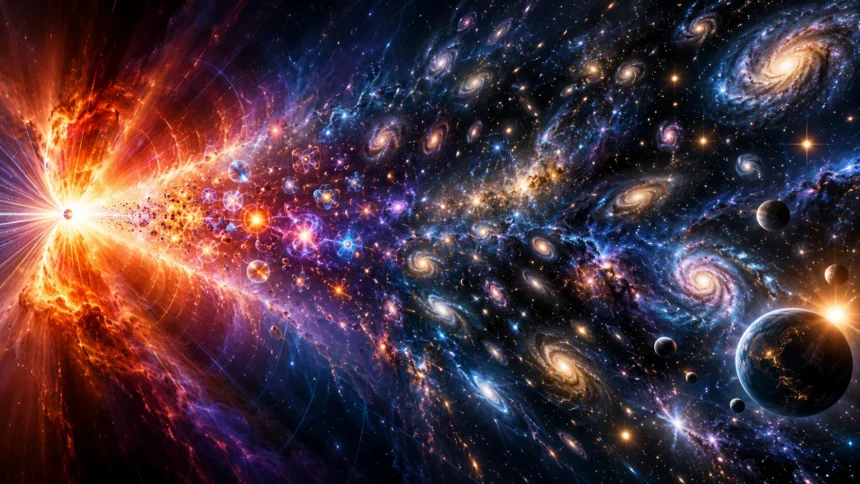
The Big Bang Theory is the scientific model that explains how the observable universe developed from an extremely hot, dense early state approximately 13.8 billion years ago. According to this model, space expanded while the universe gradually cooled. Over time, fundamental particles combined to form atoms, and gravity helped organize matter into stars, galaxies, and larger cosmic structures.
Despite its name, the Big Bang was not an ordinary explosion occurring at one location within empty space. Instead, the model describes the expansion of space itself, with distances between widely separated galaxies increasing over time. This distinction is important because the universe does not have a known central point from which all galaxies are moving outward.
The Big Bang Theory explains many observable features of the universe, including cosmic expansion, the abundance of light elements, and ancient radiation found throughout space. However, it does not provide a complete explanation of why the universe exists. Scientists continue investigating the earliest moments and the physical processes responsible for the conditions described by the model.
2. How Did the Universe Begin According to Science?
According to modern cosmology, the observable universe was once much hotter and denser than it is today. As researchers trace cosmic expansion backward, they find that matter and radiation occupied an increasingly compressed state. The Big Bang model describes the universe’s evolution from this early period, although the exact conditions at the beginning remain uncertain.
During the earliest stages, temperatures were extraordinarily high, and ordinary atoms could not exist. Instead, the universe contained intense radiation and fundamental particles interacting under extreme physical conditions. As expansion continued, temperatures declined, allowing different forms of matter to develop and creating the conditions needed for more complex structures to appear later.
Scientists sometimes describe the earliest universe using the idea of a singularity, where familiar equations reach their limits. However, a physical singularity has not been established as a confirmed description of reality. Current theories cannot reliably explain every condition at the earliest possible moment, leaving questions about the universe’s ultimate origin unanswered.
3. What Happened During the First Seconds After the Big Bang?
The universe experienced enormous physical changes during its earliest fractions of a second. Temperatures were so extreme that familiar forms of matter could not remain stable. As the universe expanded and cooled, fundamental particles interacted through forces that would eventually shape the behavior of atoms, stars, and other structures throughout cosmic history.
During these early stages, particles such as quarks, electrons, and neutrinos participated in a rapidly changing environment. Quarks eventually became bound together into particles including protons and neutrons as conditions cooled sufficiently. These developments were essential because protons and neutrons later formed the nuclei of the light elements found throughout the universe.
The early universe also contained matter and antimatter, which can release energy when corresponding particles interact. For reasons scientists are still investigating, a small excess of matter survived these early processes. That remaining matter eventually became the material from which galaxies, planets, living organisms, and countless other objects would form billions of years later.
4. How Did the First Elements Form in the Universe?
As the universe continued cooling, conditions eventually allowed protons and neutrons to combine into simple atomic nuclei. This process, known as Big Bang nucleosynthesis, occurred primarily during the first several minutes of cosmic history. It produced much of the hydrogen and helium nuclei present in the universe, along with small amounts of other light nuclei.
Hydrogen nuclei consist of single protons, while the most common helium nuclei contain two protons and two neutrons. These light elements formed under the temperature and density conditions present during the early universe. Heavier elements such as carbon, oxygen, and iron were produced much later through processes involving stars and other energetic cosmic events.
The predicted abundance of these light elements provides important evidence supporting the Big Bang model. Astronomers can study ancient gas clouds and other cosmic environments to estimate the proportions of hydrogen, helium, and related elements. The broad agreement between observations and theoretical calculations helps scientists understand how matter developed during the universe’s earliest minutes.
5. How Did the First Atoms Form After the Big Bang?
Although atomic nuclei formed within minutes, the universe initially remained too hot for electrons to stay attached to them. Energetic radiation repeatedly separated electrons from nuclei, creating a dense mixture of charged particles and light. During this period, photons interacted frequently with matter, preventing radiation from traveling freely across large distances.
Approximately 380,000 years after the Big Bang, the universe had cooled enough for electrons and nuclei to combine into neutral atoms. This important transition is commonly called recombination. Once large numbers of neutral atoms formed, radiation interacted less strongly with the surrounding matter and could travel much more freely through the expanding universe.
The ancient light released during this transition remains observable today as the cosmic microwave background. Its existence provides a remarkable window into conditions when the universe was still extremely young. Studying this radiation helps scientists reconstruct the distribution of matter, the universe’s early temperature variations, and the processes that eventually contributed to galaxy formation.
6. What Evidence Supports the Big Bang Theory?
One of the strongest pieces of evidence supporting the Big Bang Theory is the observed expansion of the universe. Astronomers have discovered that light from many distant galaxies is shifted toward longer, redder wavelengths. This phenomenon, known as cosmological redshift, is consistent with light being stretched as it travels through expanding space.
Another major discovery is the cosmic microwave background, which fills the observable universe with faint microwave radiation. This radiation has an extremely uniform temperature, with tiny variations that reveal differences in the early distribution of matter. Scientists use these patterns to investigate the universe’s age, composition, geometry, and early development.
The abundance of hydrogen, helium, and certain other light elements offers additional support for the theory. Big Bang nucleosynthesis predicts proportions broadly consistent with astronomical measurements. Together, cosmic expansion, ancient background radiation, and light-element abundances provide a connected body of evidence explaining why the Big Bang remains the leading scientific model of cosmic evolution.
7. How Did the First Stars and Galaxies Form?
After neutral atoms formed, the universe entered a long period before the earliest stars began producing significant amounts of visible light. During this time, gravity gradually drew matter into regions that were slightly denser than their surroundings. These growing concentrations of material provided the foundations for the first stars and galaxies.
The earliest stars likely formed when clouds of mostly hydrogen and helium collapsed under their own gravity. As the gas became increasingly compressed, central temperatures eventually rose enough for nuclear fusion to begin. These stars produced energy and started transforming light elements into heavier elements, making them important contributors to the universe’s chemical development.
Galaxies gradually formed as stars, gas, and dark matter assembled into larger gravitationally connected systems. Over billions of years, galaxies continued growing through star formation, interactions, and mergers with neighboring structures. The Milky Way, which contains our solar system, is one example of the complex galaxies that developed through these long-term processes.
8. What Role Did Gravity and Dark Matter Play?
Gravity played a central role in transforming the early universe from a relatively uniform distribution of matter into the complex structures visible today. Small differences in density allowed some regions to attract additional material over time. As these concentrations grew, they eventually formed the gravitational foundations of stars, galaxies, and galaxy clusters.
Dark matter is an important part of modern explanations for this cosmic development. Although scientists have not directly identified its underlying particle or substance, its gravitational effects can be observed through galaxy motion, gravitational lensing, and large-scale structure. Dark matter appears to have helped create gravitational regions where ordinary matter could accumulate and form galaxies.
Without including dark matter, many observed features of galaxies and cosmic structure are difficult to explain using current models. Its presence helps account for how structures developed from small early density differences. However, the physical nature of dark matter remains unknown, making it one of the most important unanswered questions in modern cosmology.
9. What Is Cosmic Inflation and Why Does It Matter?
Cosmic inflation is a scientific hypothesis proposing that the universe experienced an extremely rapid period of expansion during a very early stage of its development. This proposed expansion could explain several features of the observable universe, including its large-scale uniformity. Inflation is an influential theoretical idea, but its precise physical mechanism has not been confirmed.
One question inflation addresses is why widely separated regions of the universe have remarkably similar temperatures. Rapid early expansion could have stretched a previously connected region into the much larger observable universe. Inflationary models can also explain how extremely small quantum fluctuations might have developed into the initial density variations that later supported cosmic structure formation.
Scientists investigate inflation through observations of the cosmic microwave background and the distribution of galaxies. Certain predictions are consistent with existing measurements, but different inflation models remain possible. Researchers continue searching for additional evidence that could distinguish between competing explanations and reveal more about the physics governing the universe’s earliest accessible stages.
10. Why Is the Universe Still Expanding Today?
The universe continues expanding because cosmic expansion is an ongoing feature of its large-scale evolution. As space expands, distances between many gravitationally unbound galaxies increase over time. This does not mean individual galaxies, planets, or ordinary objects expand in the same way, because local gravitational and other forces maintain their structures.
Astronomical observations indicate that the universe’s expansion is currently accelerating rather than slowing continuously under the influence of gravity. Scientists use the term dark energy to describe the unknown component associated with this acceleration. Although dark energy appears to dominate the universe’s overall energy budget, its fundamental nature remains one of cosmology’s greatest mysteries.
Different theoretical models suggest different possibilities for the universe’s distant future. Under the commonly used cosmological model, expansion would continue, and distant galaxies would become increasingly separated. However, future predictions depend on how dark energy behaves over extremely long periods, meaning scientists continue testing whether the current understanding of cosmic expansion is complete.
11. What Happened Before the Big Bang and What Remains Unknown?
One of the biggest questions about the universe is whether anything existed before the hot, dense state described by the Big Bang Theory. Current scientific understanding cannot provide a confirmed answer. Because space and time are deeply connected in modern physics, the meaning of a period before the earliest universe may be more complicated than ordinary experience suggests.
Some scientific models explore possibilities such as cosmic bounces, earlier phases of expansion, or processes involving quantum gravity. These ideas attempt to explain conditions beyond the limits of established Big Bang calculations. However, they remain subjects of theoretical investigation, and scientists have not obtained sufficient observational evidence to establish one explanation as correct.
Other unresolved questions concern the origin of cosmic inflation, the nature of dark matter, and why matter became more abundant than antimatter. Researchers also continue examining how gravity behaves under extreme quantum conditions. Answering these questions could significantly improve our understanding of the universe, although the Big Bang model already explains many important features of cosmic history.
Conclusion
The Big Bang Theory provides the leading scientific explanation for how the observable universe developed from an extremely hot and dense early state approximately 13.8 billion years ago. As the universe expanded and cooled, fundamental particles formed atomic nuclei, neutral atoms appeared, and gravity gradually assembled matter into stars and galaxies. These processes established the foundations of the cosmic environment we observe today.
Scientific discoveries involving cosmic expansion, the cosmic microwave background, and the abundance of light elements strongly support this model. However, the theory does not answer every question about the universe’s ultimate beginning. Mysteries surrounding inflation, dark matter, dark energy, and the earliest possible conditions continue motivating astronomical observations and theoretical research.
Understanding what the Big Bang Theory is helps reveal how the universe has changed across billions of years. It also demonstrates how scientists use observable evidence to reconstruct events that occurred long before Earth or the solar system existed. Although many questions remain unanswered, the Big Bang model offers a powerful framework for exploring the universe’s remarkable history and continuing evolution.
Frequently Asked Questions (FAQs)
1. What is the Big Bang Theory in simple words?
The Big Bang Theory explains how the universe evolved from an extremely hot, dense early state about 13.8 billion years ago. As space expanded and cooled, matter eventually formed stars, galaxies, and planets.
2. Did the Big Bang happen in empty space?
No, the Big Bang was not an explosion occurring at one location inside empty space. It describes the expansion of space itself, so scientists do not identify a central explosion point within the universe.
3. How old is the universe according to the Big Bang Theory?
The universe is approximately 13.8 billion years old according to current cosmological measurements. Scientists estimate this age using observations of cosmic expansion, ancient background radiation, and models describing the universe’s development.
4. What existed before the Big Bang?
Scientists do not currently know whether anything existed before the earliest stages described by the Big Bang model. Some theories propose earlier cosmic phases, but these possibilities have not been confirmed through observations.
5. Is the Big Bang Theory scientifically proven?
The Big Bang Theory is strongly supported by several independent lines of scientific evidence, including cosmic expansion, background radiation, and light-element abundances. However, scientists continue investigating its earliest stages and unresolved questions.